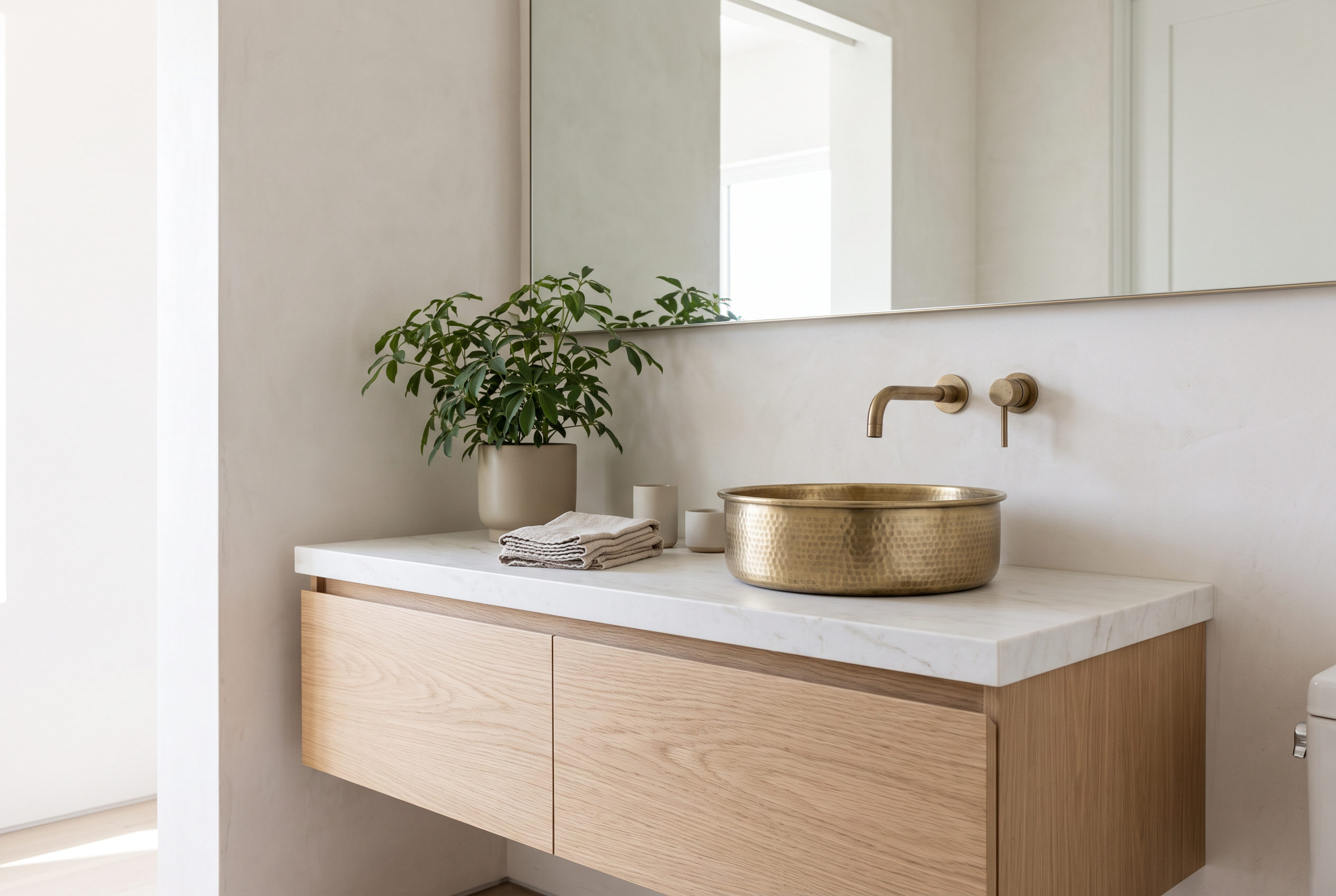
A hammered brass sink is a basin made from solid brass and dimpled by hand with a hammer. The dents catch light, hide water spots and give the metal a depth that smooth fixtures lack. Choose the mounting style first (vessel, undermount or drop-in), then decide whether you want the brass to darken naturally or stay bright.
Key takeaways
- Hammering is a texture, not a finish. The sink can still be bright, aged or unlacquered.
- Untreated brass patinates. Makers of hammered brass sinks say so openly, so decide up front if you want that.
- Vessel sinks suit powder rooms. Undermount sinks suit busy family bathrooms.
- Check that the basin is solid brass, not plated, and whether it includes an overflow.
In this guide
- What is a hammered brass sink?
- Which brass bathroom sink style suits your vanity?
- What size and depth should you choose?
- Will a hammered brass sink patina?
- What looks good around a brass vessel sink?
- What should you check before buying?
- Frequently asked questions
What is a hammered brass sink?
Hammered metalwork is one of the oldest crafts in Moroccan workshops, where brass and copper basins, trays and lanterns are still shaped and dimpled by hand. A hammered brass sink applies the same idea to the bathroom. A flat sheet or spun bowl of brass is worked with a hammer until the whole surface carries a soft, faceted texture.
That texture has a practical side. Light breaks up across the dimples, so fingerprints and water marks are far less visible than on a smooth polished bowl. No two sinks are identical, which is the point.
Which brass bathroom sink style suits your vanity?
The mounting style changes how the sink looks, how it is cleaned and what the counter needs to be. Most hammered brass basins on the market come in three forms.
| Style | Look | Cleaning | Best for |
|---|---|---|---|
| Vessel | Sculptural bowl above the counter | Easy to reach all sides, rim can collect splashes | Powder rooms, guest baths, floating vanities |
| Undermount | Counter edge meets the bowl, rim hidden | Wipe water straight into the bowl | Family bathrooms, stone counters |
| Drop-in | Rim sits on the counter | Needs attention where rim meets counter | Retrofits, wood or tiled counters |
A brass vessel sink makes the most visual noise, so keep the faucet simple. Undermount versions are the more practical choice, and they sit well against stone or a zellige backsplash. Our Moroccan bathroom ideas show how brass sits with plaster and tile in a wet room.

What size and depth should you choose?
Round hammered brass basins are commonly sold at roughly 13 inches up to about 16.5 inches across, with bowl depths of around 5 to 7 inches. Rectangular undermount versions run closer to 20 inches wide. Prices vary widely. Handmade vessel basins from independent workshops often start in the low hundreds of dollars, while branded undermount sinks from US makers commonly sit between about $600 and $1,000.
- Check the bowl diameter against the cut-out your counter allows, and leave elbow room around the faucet.
- Ask whether an overflow is included. Some hammered brass sinks have one and some do not.
- Confirm the drain size and whether the drain is sold separately.
- For a vessel sink, match faucet height to the basin so water lands inside the bowl.
Will a hammered brass sink patina?
Yes, unless it has been coated. Manufacturers of hand-hammered brass basins state that the metal will naturally patinate if left untreated, and that it needs some care. Water, soap and skin oils all speed up the change. The color usually deepens first in the dimples while the raised edges stay brighter, which is why hammered brass ages so well.

You have two routes. Leave it unlacquered and accept the changing color, or buy a sink with a protective coating or wax finish if you want it to stay as it is. Some retailers note that patina can start immediately if the metal is not waxed straight away, so ask what finish the sink arrives with. For a deeper comparison of how brass and copper age, see brass vs copper sinks.
Pro tip
Dry the bowl with a soft cloth after use and avoid abrasive pads and harsh cleaners. A gentle soap and warm water are enough for daily care. Follow the maker’s care sheet, because a coated finish and a raw finish are cleaned differently.
What looks good around a brass vessel sink?
Because the bowl already has texture, give it calm surroundings. These pairings work in ordinary modern bathrooms.
- Light oak or walnut vanity: the wood warms the brass without competing with it.
- White stone or quartz counter: a clean surface lets the hammered bowl take center stage.
- Handmade zellige backsplash: sage, white or pale grey tile reflects light unevenly and echoes the sink’s irregularity. Read our zellige tile guide before you order.
- Matching brass faucet: keep the finish consistent, or deliberately contrast it with matte black for a more modern look.
- One green plant and a simple mirror: stop there. The sink is the accent.
What should you check before buying?
- Ask for the material in writing. Solid brass behaves very differently from plated metal or a brass-colored finish on another base.
- Confirm the finish: unlacquered, waxed or coated, so you know how it will age.
- Check the mounting type, drain size and overflow before the vanity is cut.
- Look at photos of the actual sink. Hand-hammered texture varies, so a small sample is a good sign of honesty.
- Have a plumber confirm compatibility with your faucet and drain, especially for vessel installs.
Frequently asked questions
Is a hammered brass sink hard to maintain?
It is easy if you accept some change in color. Dry it after use, clean with mild soap and avoid abrasive products. If you want a fixed color, choose a coated or waxed finish.
Will a brass bathroom sink tarnish?
Untreated brass patinates over time, and makers of hammered brass basins say so. Coated finishes slow the change, but nothing is fully permanent, so ask about the finish.
What is the difference between a brass vessel sink and an undermount?
A vessel sink sits above the counter as a sculptural bowl. An undermount sits below the counter edge, so the rim is hidden and the counter wipes clean into the bowl.
How much does a hammered brass sink cost?
Prices vary by maker, size and finish. Independent workshop vessel basins often start in the low hundreds of dollars, while branded undermount sinks commonly cost roughly $600 to $1,000.
Can you use a hammered brass sink in a kitchen?
Yes, small hammered brass sinks are sold for bars and prep areas. Check the maker’s guidance on food and cleaning products, and ask about the finish before you buy.
Does a hammered brass sink need an overflow?
It depends on the model and your local plumbing rules. Some sinks include an overflow and some do not, so confirm before ordering and ask a plumber if unsure.